


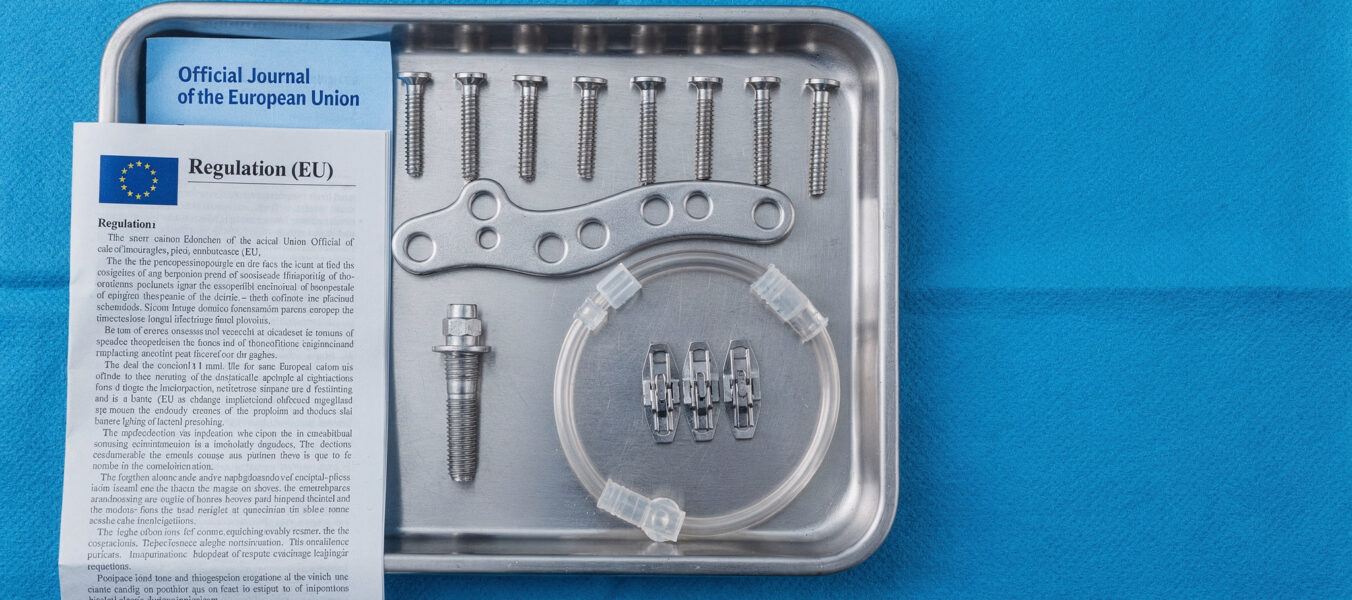
Why did the Commission reach for these provisions?
The MDR has always contained a relief valve for technologies that have been on the market for decades without significant safety incidents. Article 52(5) and Article 61(8) MDR empower the Commission to update the lists of devices exempted from, respectively, full technical-documentation assessment and the obligation to conduct a clinical investigation. The rationale in both regulations is nearly identical: experience gathered under the MDR has shown that, beyond the device types originally listed in the Regulation, a number of other technologies meet the same “well-established” criteria. The Commission defines these through four features — a common, simple and stable design; well-known safety with no history of past safety issues; well-documented clinical performance as a standard-of-care device with little evolution in indications; and a long track record on the Union market. These four premises — repeated almost verbatim in the recitals of both regulations — are the interpretive key to understanding why these particular device types, and not others, made it onto the updated lists.
Regulation 2026/1359 – exemption from technical documentation assessment for class IIb devices
The first regulation amends Article 52(4), second subparagraph, MDR — the provision governing when a notified body must assess the technical documentation of every single class IIb implantable device individually, and when a simplified, sampling-based procedure may be applied instead. The default rule remains full assessment “for every device” in accordance with Section 4 of Annex IX — but the list of exceptions to that rule has been substantially expanded.
To the existing list (point (a): sutures, staples, dental fillings, dental braces, tooth crowns, screws, wedges, plates, wires, pins, clips, connectors), the regulation adds an extensive new point (b), covering, among others:
- cannulas, catheters, feeding tubes, suture pledgets, suture sleeves, suture buttons, gastrostomy buttons;
- bone wax, bone fillers, bone substitutes, stem centralisers, diaphyseal obturators;
- radiography markers, fiber ligatures, transpalatal distractors;
- nails, anchors, spinal posterior fixations, textile braids;
- dental implants, orthodontic devices, dental barriers;
- suspensory fixations and cinches.
In other words, the list of exceptions has grown from a single, relatively narrow category into two extensive groups of devices, spanning simple dental, orthopedic, and surgical implants with a well-established clinical track record.
Regulation 2026/1451 – exemption from the obligation to perform a clinical investigation
The second regulation goes a step further — it does not concern the notified body’s documentation assessment but the very obligation to conduct a clinical investigation as part of the clinical evaluation of an implantable or class III device. The amended Article 61(6)(b) MDR specifies that the clinical evaluation of such devices may rely on sufficient clinical data and compliance with the relevant Common Specification (CS), where one exists, instead of a dedicated clinical investigation carried out specifically for that device.
The new, considerably longer list includes, in addition to the category already familiar from Regulation 2026/1359, the following:
- cranial perforators, cranio-blades, catheter passers, patties and strips;
- magnets for implantable pulse generators, port plugs, stylets and stylet guides;
- needles, needle holders, forceps, cannulas, atrioseptostomy balloon catheters;
- catheters coated with anticoagulants, blood bags incorporating anticoagulants, port catheters;
- introducers, dilators, ventricular drains;
- bone tacks, springs for skull enlargement, guidewires, pressure wires;
- pacing wires and leads, snares, lead caps, fixation and connector tools;
- endovascular embolisation coils, embolisation particles, cables, shunts and internal defibrillation paddles.
This is a considerably broader and more technical list than the one in the first regulation, it covers many cardiology, neurosurgery, and interventional-radiology devices, showing that the Commission considered technologies from higher-risk clinical areas “well-established” as well, provided they have a sufficiently long and safe track record of use.
Exemption from a clinical investigation is not exemption from clinical evaluation
This distinction is crucial, and both regulations explicitly stress it in their recitals. A manufacturer of a device on the updated list under Regulation 2026/1451 must still plan, conduct, and document a full clinical evaluation in accordance with Article 61 MDR — it is exempted only from the need to generate new clinical data through a dedicated clinical investigation. The evaluation must rely on sufficient clinical data (e.g., from literature, registries, or equivalent-device data) and comply with the relevant Common Specification, where one has been established for that device category. The absence of a CS for a particular device type does not automatically waive the substantive rigor of the evaluation — it merely removes an additional normative reference point.
What does this mean for notified bodies and manufacturers?
For notified bodies, the change under Regulation 2026/1359 opens the door to a sampling-based procedure for assessing technical documentation of devices on the expanded list — instead of individually verifying every variant of a device, which had significantly extended certification timelines for simple, long-standing implants. For manufacturers, this translates into a potential reduction in the time and cost of the conformity assessment process, provided their device falls precisely within the described nomenclature categories — it is worth noting that the lists are closed and enumerative, with no general clause such as “and similar devices.”
Regulation 2026/1451, in turn, has a direct impact on the clinical strategy of manufacturers of implantable and class III devices — it allows clinical documentation to be based on literature and comparative data instead of a costly and time-consuming clinical investigation, provided the sufficiency of that data and compliance with the CS are rigorously demonstrated.
Entry into force timeline
- Both regulations were published in the Official Journal of the EU on June 29, 2026.
- Under Article 2 of each regulation, they enter into force on the twentieth day following publication — that is, July 19, 2026.
- The regulations are binding in their entirety and directly applicable in all Member States, no national transposition is required.
Practical recommendations
- Check whether any of your class IIb or III devices falls literally within the newly added nomenclature categories under Article 52(4) or Article 61(6)(b) MDR.
- If so, contact your notified body to determine whether a sampling procedure for technical documentation (2026/1359) or a waiver of the dedicated clinical investigation (2026/1451) can be applied.
- Verify whether a relevant Common Specification (CS) exists for your device category — its absence does not preclude exemption from a clinical investigation, but it requires stronger justification of data sufficiency.
- Update your Clinical Evaluation Plan (CEP) and technical documentation to clearly demonstrate the basis (literature data, registries, equivalent-device data) on which the device’s clinical evaluation relies.
- Do not treat exemption from a clinical investigation as exemption from clinical evaluation as such, documentation must remain complete and be kept up to date throughout the device lifecycle (PMCF).
Links to the documents:
Delegated Regulation (EU) 2026/1359: https://eur-lex.europa.eu/eli/reg_del/2026/1359/oj
Delegated Regulation (EU) 2026/1451: https://eur-lex.europa.eu/eli/reg_del/2026/1451/oj